Thursday, 19 July 2012

Bee Keeping

I have been doing a beekeeping course with the North Bucks Bee Keepers’ Association and have learn' t lots of things about bees.
Bees have been kept for honey production quite successfully in earthenware pipes, straw skeps, wooden boxes and all types of hives. The most popular type of hive in the UK is the National hive and consists of a roof, crown board, super (chamber were bees store honey), brood chamber (were the Queen lays all the eggs), entrance block and the floor.
There are three different types of bees in a bee hive. The majority of bees are workers (sterile females). They collect nectar to make honey. A worker bee’s lifespan can be as little as five weeks and as long as six months. Drones are distinctly bigger than worker bees and don't sting unlike worker bees. The drones are male and get to fertilise the Queen bee although they usually die when they have mated with the Queen bee. The Queen bee has a longer body than the worker bees and lays all of the eggs for new bees in the bottom of the bee hive. She can live for up to five years.
The Queen bee who is fertilised by drones lays all her eggs on frames of wax in the brood chamber at the bottom of the bee hive. Honey is also stored on these frames of wax in the brood chamber. Honey is also stored in Supers (or upper chambers).

This is a brief summary of the bee keeper’s year:
January
Check that there are sufficient stores (Stores is the honey stored around the brood chamber for feeding larvae)
February
Check that there are sufficient stores
Crumbs on board shows the hive is being used
March
Check all colonies are flying
April
First inspection
May
Continue inspections, 7 – 10 days
Keep records
June / July
Continue inspections
August
Remove honey
September / October
Treat for varroa (if not done in August). Varroa is a debilitating blood-sucking mite that infests bees.
Check if treatment temperature dependent
November / December
Check that there are sufficient stores
Protect against woodpeckers and mice

The waggle dance is the figure-of-eight dance bees use to communicate good places to forage.

Swarming—The biggest reason for bees to swarm is overcrowding. If a colony gets too big for the hive the queen will lay eggs in special queen cells, then leave the hive with about half of the workers to find a new home.
The remaining workers will look after the developing queen larvae. The first one to emerge will kill the other developing queens, then a few days later will go out on a mating flight with the drones. On her return she will take up where the old Queen left off.

Some of the pests and diseases bees can get are:
Varroa - a debilitating blood sucking mike which is about 1.7mm long.
Nosema - a micro-organism that a lot of bees carry which can cause dysentery when the bees are stressed.
CHALK BROOD - leaves mummified, chalky larvae in the brood frames were bees keep the young and is not considered serious.
FOULBROOD - a serious bee disease which comes in the form of American Foulbrood (AFB) or European Foulbrood.
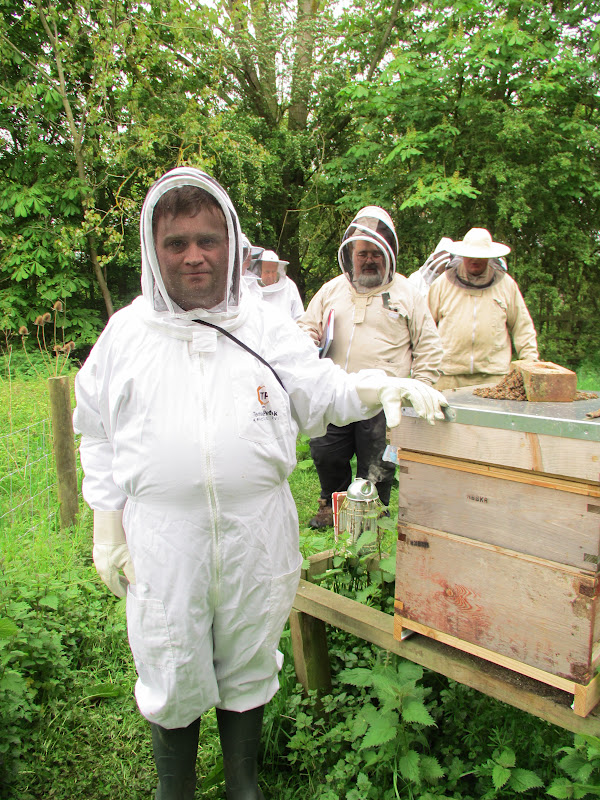
Me wearing a bee suit.
Bee hives
Smoking a hive. Smoking relaxes bees so they won't sting.
Inside a bee hive.
Frames.
Marking the Queen Bee in a cage with a yellow dot.
The yellow dot on the Queen bee makes her easy to find.
A frame.
 Alex Fox

Friday, 13 July 2012

Camphill Communities Medieval Fayre

These are some photos of the Medieval Summer Fayre that happened on Saturday 7th July 2012 at Camphill Milton Keynes.People dressed up in medieval costumes and the deputy mayor of Milton Keynes, Brian White officially opened the new Camphill Milton Keynes shop with Max Barton, a resident and Camphill Milton Keynes for the public.
Sign.
Andrew and Freddy in medieval costumes.
Stalls in the theater.
Some more stalls.
A dragon.
The barbecue.
Opening the shop for the public.
Alex Fox

Wednesday, 4 July 2012

Land Day

On Monday 2nd July 2012, residents and co-workers had a land day at Camphill Milton Keynes. There were groups of people who did weeding, clearing litter and making the gardens around the houses look nice. It went on all day and the only other workshops were the Cafe and the Bakery. I took lots of photos.
People did weeding in the paddock and around the gardens   in the community. We also cleaned up any grass, leaves or old branches from trees on the estate. The weather was not great; it rained for some of the day although the grounds around the community look a lot better. I did not take part in much of the maintenance since I got quite stung in an accident on a bee keeping course I took part in the day before.
It was a great opportunity for everybody to get together in groups since there are so many people living in the community.


Alex Fox

Trip to Cornwall

On 11th May 2012 Rodrigo, Kim, Stuart Gregory, Anthony and I went on a short holiday to Cornwall near Wales. We stayed in a small cottage. We had to do all our own shopping as it was self-catering. The owner of the cottage had a place next to ours.  On the way there we stopped off to visit Nick Jackson and Joan Platford who used to live in Camphill Milton Keynes.
We had a few days so we went to the beach although I did not go into the sea. We took a ferry to visit Plymouth and Stuart, Kim and I went on a big wheel ride. We also went to visit Matthew Jackson who is at university. He is Nick Jackson’s and Joan Platford’s son.
We also had meals out at the pub and also went to a restaurant that cooked local food and had a nice waitress.
We went back to Camphill Milton Keynes on Tuesday 15th May. I thought that the holiday was fun and think that the community should do more short holidays.


Where we stayed.
On the beach.
Visiting Matthew Jackson.
Group photo.
Alex Fox

Friday, 29 June 2012

St John's Day

These are some photos of St John's Day which was on Sunday 24th June. Residents and co-workers from Camphill Milton Keynes went to Camphill Delrow which is another Camphill Community in Watford. There was eurythmy, singing and people from Camphill Milton Keynes performed some poetry. There was also a bonfire lit.
Michael Luxford.
Eurythmy.
Singing.
Camphill Milton Keynes performing poetry.
Lighting the St John's fire
The St John's fire.
Alex Fox

Wednesday, 27 June 2012

Residents Conference and opening of new shop

On Tuesday 19th and Wednesday 20th June 2012 residents of Camphill Milton Keynes had a conference in the Chrysalis Theatre which is part of Camphill Milton Keynes. There were such topics such as Speaking up for ourselves and others, Residents voice in the community, Sharing ideas and Advocacy. 
The conference was to allow residents to contribute in a meaningful way to the running of the community.
In the afternoon on Wednesday we finished off the conference with Julian Armstrong who has been living at Camphill  Milton Keynes the longest cutting the ribbon to the doors of the new shop in Camphill Milton Keynes. The shop sells things from the garden, and from the bakery, from the craft workshops in the community and some Weleder products.

Shirley doing a talk
Doing group work
Presenting what we did in groups
Playing a game
Residents putting a hand print on a long piece of paper
Hand prints
Outside of the shop
Julian cutting the ribbon
In the new shop
Cake
Alex Fox

Friday, 22 June 2012

Ceremony for the 32nd Anniversary of the Milton Keynes Peace Pagoda

The Milton Keynes Peace Pagoda was completed in 1980 at the northern edge of Willen lake in Willen, Milton Keynes. This was the first Peace Pagoda in the western world. There is a Nipponzan Myohoji Order temple and monastery nearby.
On Sunday 17th June 2012 there was a ceremony at the Peace Pagoda to celebrate it's 32nd year of being built. There were prayers, addresses and messages of peace. There were also multi-cultural events including a poem and acting from people from Camphill Milton Keynes.


Milton Keynes Peace Pagoda.
Monks from the temple.
People from Camphill Milton Keynes performing at the Peace Pagoda.
Alex Fox