Friday, 17 January 2020
Friday, 10 January 2020
Wreath Making
These are photographs of residents and staff of Camphill Milton Keynes making Christmas Wreaths to hang on the doors of our houses.
A wreath is an assortment of flowers, leaves, fruits, twigs, or various materials that is constructed to form a ring.
In English-speaking countries, wreaths are used typically as household ornaments, most commonly as an Advent and Christmas decoration. They are also used in ceremonial events in many cultures around the globe. They can be worn as a chaplet around the head, or as a garland around the neck. Wreaths have much history and symbolism associated with them.
They are usually made from evergreens and symbolize strength, as evergreens last even throughout the harshest winters. Bay laurel may also be used; bay laurel wreaths are known as laurel wreaths.
Alex Fox
Friday, 3 January 2020
People's Partnership Board Meeting
On Thursday 14th November, there was the People’s
Partnership Board meeting. This event was held at the
Church of Christ the Cornerstone in Milton Keynes.
The meeting started at
10.00 with people signing
in and then being guided
to tables. There was a
welcome and brief
outlying of the day. Then
there was a video called
‘Just like you’. And there
were performers who did
dancing.
When the performers had
finished there was a
themed table workshop
session (people could
move around 3 tables or more). The event room hall was
a round room with 8 pillars around the outside. Each of
these pillars was a zone with a rectangle table and 8
chairs. The zones/tables people could
choose from were Transport, Access to
healthcare, Relationships, Education/
Employment, My social life,
Accessible places/information,
Housing/Isolation and Citizenship/
Voting. On each table there were
general flyers on Belonging, pictures
to aid conservation and a ‘Fact and
Feedback’ sheet to prompt
conservation.
After the workshop we had a break
time. Then there was another film
called ‘Belonging’. After the film
there was a round up where we
were able to share ‘Top 2’ issues
raised in the workshop. After this
there was an evaluation to explain what will be
happening to any feedback. I thought this event was
interesting.
Alex Fox
Friday, 20 December 2019
Handmade Craft, Art & Food Fair
On Saturday 9th November, there was a handmade craft, art and food fair held at Camphill Milton Keynes. A lot of it was held in the Chrysalis Theatre. There was a Christmas Market. Also there were arts and craft stalls, seasonal food for sale, games and a raffle and guests from other charities. There was a festive atmosphere. In the Cafe, there was an art exhibition with paintings and Christmas cards produced by local artists from Milton Keynes.
Alex Fox
Friday, 13 December 2019
Halloween Party
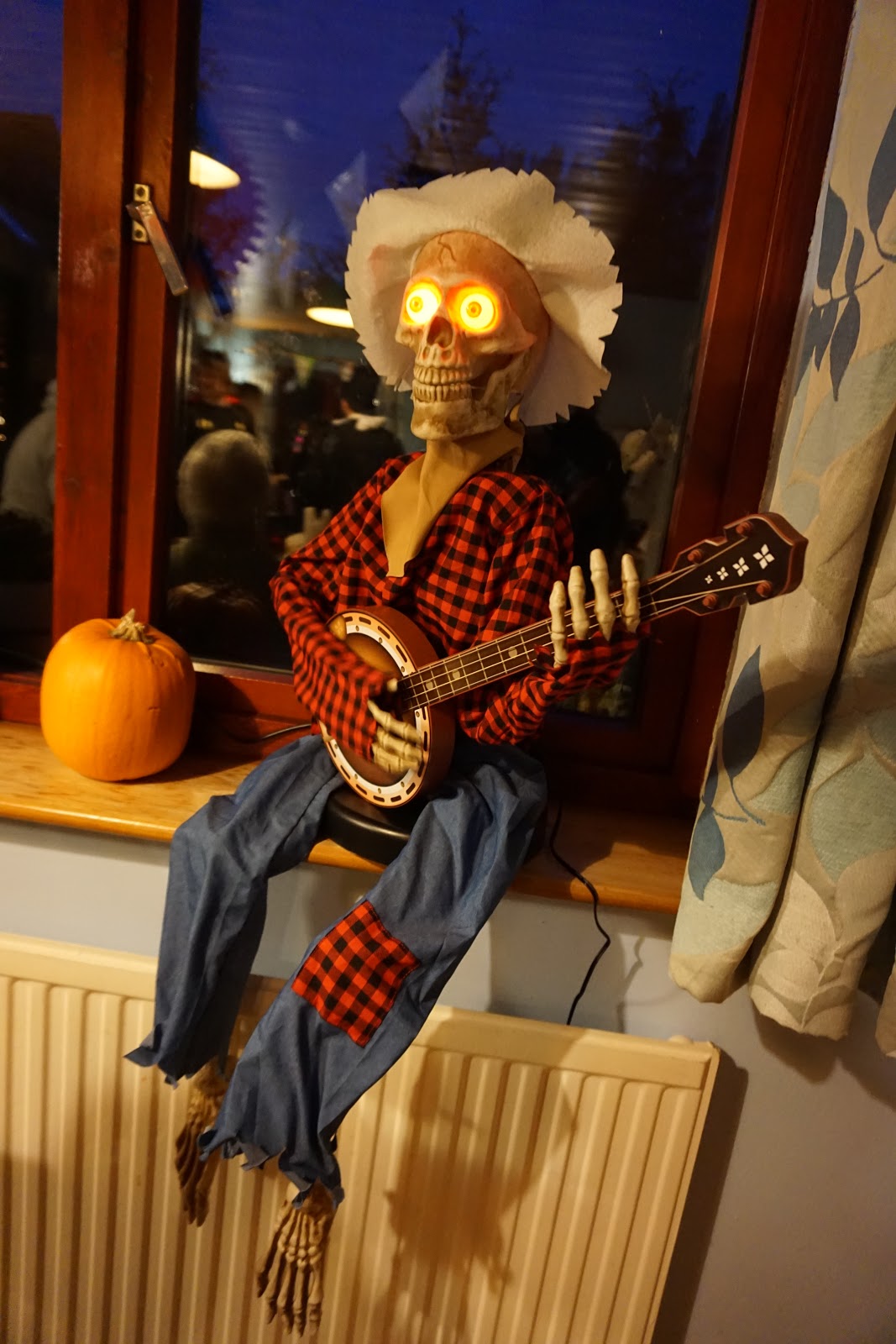
On Thursday 31st October, residents and co-workers from Camphill Milton Keynes had a Halloween party at Blackthorn House in Camphill Milton Keynes.
Why do we celebrate Halloween?
The three days between 31st October and 2nd November see pagan and Christian celebrations intertwined in a fascinating way and is a perfect example of superstition struggling with religious belief.
Currently, it is widely thought that Halloween originated as a pagan Celtic festival of the dead related to the Irish and Scottish Samhain, but there is no evidence that it was connected with the dead in pre-Christian times.
Why do we celebrate Halloween?
The easy answer to this question is that no one really knows the origins of Halloween.
What we do know for sure is that Halloween is on the eve of a major Catholic festival, All Saints (1st November) and the eve of the pagan Celtic festival known as Samhain.The three days between 31st October and 2nd November see pagan and Christian celebrations intertwined in a fascinating way and is a perfect example of superstition struggling with religious belief.
Currently, it is widely thought that Halloween originated as a pagan Celtic festival of the dead related to the Irish and Scottish Samhain, but there is no evidence that it was connected with the dead in pre-Christian times.
Alex Fox
Friday, 6 December 2019
Alpaca Trek
These are photographs of residents of Camphill Milton Keynes going on an Alpaca Trek. We did this at a place called Holly Hagg Community Farm in Sheffield.
Alpacas are members of the camelid family. The camels that most people are familiar with are the ones with humps; the dromedary of Northern Africa, the Middle East, and Southern Asia, and the Bactrian camel of China and Tibet. However, there are four other camelids (without humps) that are indigenous to South America: two of them, llamas and alpacas, have been domesticated for thousands of years; whereas the other two varieties, guanacos and vicunas, continue to roam in wild herds today.
The alpaca comes in two breed-types: huacaya (pronounced wah‑KI‑ah) and suri (SOO‑ree). Huacayas, the more common type, account for about 90% of all alpacas, and have fluffy, crimpy fleece that gives the animals a teddy bear-like appearance. Suris, on the other hand, grow silky, lustrous fleece that drapes gracefully in beautiful pencil-locks.
Alex Fox
Subscribe to:
Posts (Atom)